
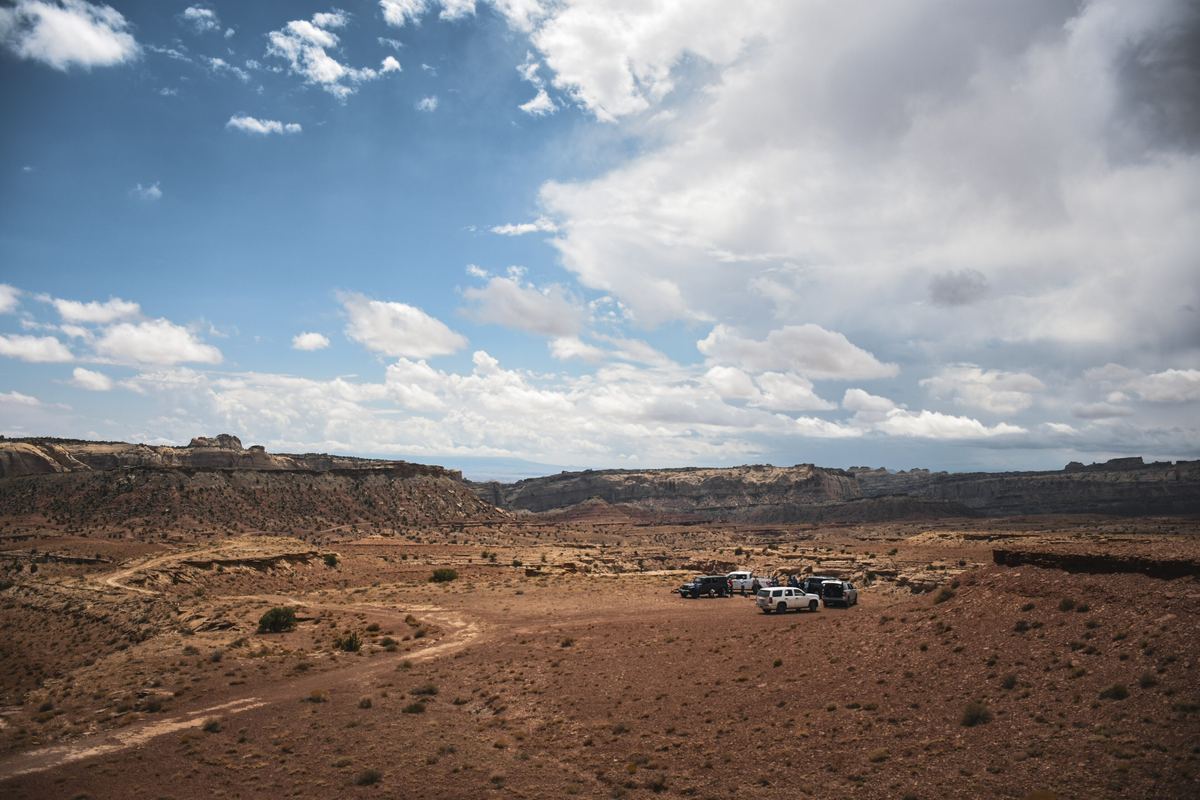
Many of the best campsites on our routes have no hookups: Mather on the South Rim with its water restrictions, the Joshua Tree campgrounds, BLM land outside Moab. The RV's house battery runs the lights, the water pump and the fridge controls, but phones, cameras and a laptop need their own plan. Here is how power works in a rented RV, and the few things that keep everything charged without running the generator all day.
About the shopping links on this page: we name product types, not brands, and link to Amazon searches. These are affiliate links, each marked: As an Amazon Associate, Runway to Rim earns from qualifying purchases. You don’t pay more, and it never decides what we recommend. Nobody paid to be mentioned here. See our affiliate disclosure.
Quick answer
- Charge while you drive. A 12 V USB-C car charger in the dash socket is the cheapest power you'll get [A].
- Bring a power bank in your carry-on, under 100 Wh. Power banks are not allowed in checked bags [S1].
- Use the generator only in its hours. Many park campgrounds limit it to a few slots a day [S2].
- Solar is optional. Worth it only for several nights in a row without hookups [A].
How power works in a rental RV
| Source | What it runs | When it works |
|---|---|---|
| Engine and dash socket (12 V) | USB chargers, phone on the mount | While driving. Don't charge for hours with the engine off: you can drain the starter battery [A] |
| House battery (12 V) | Lights, water pump, fans, fridge controls, sometimes USB sockets | Always, until it runs low. It recharges while you drive or on the generator [A] |
| Generator (Class C) | 110 V sockets, microwave, air conditioning | Only in the campground's generator hours. Some rentals charge per hour of use; check your contract [S2][A] |
| Shore power (hookup) | Everything | At sites with electric hookups: private RV parks, some state parks, a few park campgrounds [A] |
Campervans often have no generator and a smaller house battery. Read the listing: some have a solar panel on the roof, some only a USB socket [A]. Class C vs. campervan compares the two.
Generator hours
Generators are loud, so park campgrounds restrict them. At Joshua Tree, for example, campgrounds have no hookups and generators may run only 7–9 am, noon–2 pm and 5–7 pm [S2]. Other campgrounds on our routes set their own hours or ban generators entirely; the campground tables in each day-by-day itinerary list them where they're published. Plan your charging around those windows, or around the drive.
The charging kit
Five items, from essential to optional. Start with the first two; most trips need nothing more.
USB-C power bank
The one thing everyone should bring. It charges phones on the trail and at camp, and it has to go in your carry-on anyway [S1]. A 20,000 mAh bank is about 74 Wh, comfortably under the 100 Wh limit [A].
Look for: USB-C in and out, 20,000 mAh or less, the Wh rating printed on the case (airport staff look for it).
See USB-C power banks on AmazonAmazon affiliate link.
12 V USB-C car charger
Rental cabs have a 12 V socket but often old or no USB ports. A two-port charger turns every driving day into a charging session for two phones.
Look for: two ports, at least one USB-C with fast charging, a short cable or two.
See car chargers on AmazonAmazon affiliate link.
LED lantern
Campsite nights are dark, and park campgrounds don't light the picnic tables. A rechargeable lantern saves the RV battery and lights dinner outside. A headlamp is on the packing list anyway; the lantern is the comfort upgrade.
Look for: USB-rechargeable, a warm or dimmable setting, a hook to hang it.
See LED lanterns on AmazonAmazon affiliate link.
Small 12 V inverter
For a laptop or a camera charger that needs a 110 V plug while you drive. Keep it small: a dash socket can't feed a big inverter, and you don't want to drain the starter battery [A].
Look for: around 150 W, plugs into the 12 V socket, has a fan and a USB port; use it with the engine running.
Skip it if: everything you carry charges over USB-C.
See small inverters on AmazonAmazon affiliate link.
Entry-level folding solar panel (optional)
Worth it only if you plan several nights in a row with no hookups and no generator, for example on BLM land. A folding panel charges a power bank or a small power station in the sun at camp [A].
Look for: foldable, 60–100 W, USB-C output; a small portable power station if you want to store the energy.
Skip it if: you sleep at hookup sites most nights or drive every day.
See folding solar panels on AmazonAmazon affiliate link.
Simple habits
- Charge everything on the drive and at hookup sites. Arrive at a dry campsite with full batteries.
- Download maps and confirmations while you have Wi-Fi; searching for signal empties a phone fast [A].
- Turn off the RV's lights, fans and water pump when you leave the site.
- In heat or cold, batteries drain faster. Don't leave power banks on the dashboard in the sun [A].
Sources and how we checked
Checked 2026-10-29. Airline, park and rental rules change; confirm with the airline, the park and your rental company before you travel.
- [S1] FAA PackSafe — Lithium batteries (spare batteries and power banks carry-on only; 100 Wh limit; 101–160 Wh with airline approval, max two) — www.faa.gov/hazmat/packsafe/lithium-batteries (checked 2026-10-29)
- [S2] NPS Joshua Tree — Campgrounds (no hookups; generators 7–9 am, noon–2 pm and 5–7 pm only) — www.nps.gov/jotr/planyourvisit/campgrounds.htm (checked 2026-10-29)
Ready for a night without hookups?
Find campgrounds near each parkPark, BLM, national forest and private RV parks, route by route
Affiliate note: the Amazon links on this page are affiliate links. As an Amazon Associate, Runway to Rim earns from qualifying purchases. You don’t pay more. We don't accept paid rankings. See our disclosure.